IT service operations · Python · Case study 02
CasePilot
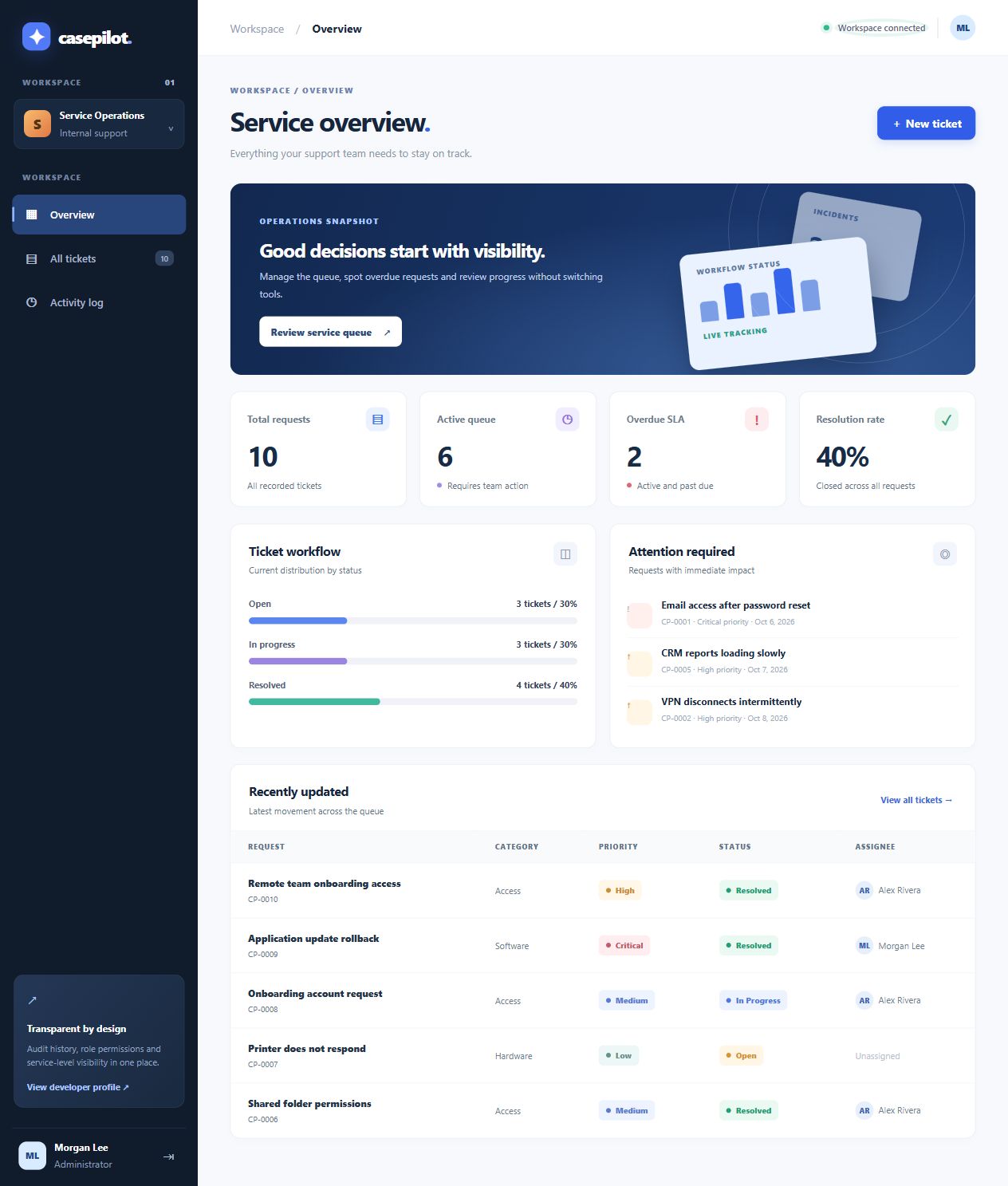
A support queue with ownership, service deadlines and an activity trail. Run it locally without a cloud account.
Python / SQLite / JavaScript / HTTP
The browser demo uses fictional data stored on this device. It simulates the workflow without running the Python backend or authenticating users.
The problem
A support team needs to see which requests are pending, who owns them and what changed. CasePilot turns that queue into an inspectable workflow with explicit permissions.
The implemented workflow
- Sign in as the local administrator or support agent.
- Create and filter requests by status, priority and reference.
- Assign a request, investigate it and add an internal note.
- Resolve or reopen the request and inspect its audit history.
- Review service-deadline metrics and export a filtered CSV.
Architecture and decisions
The browser uses a small JavaScript client and authenticated HTTP endpoints. Python handles validation, sessions, CSRF and workflow rules. SQLite stores users, requests, comments and append-only application audit events. Changes and audit entries share a transaction. SQL pagination keeps the queue bounded.
Verified on Windows · 7 October 2026
What was checked
22 HTTP integration tests and 4 frontend tests passed on Windows. Coverage includes role permissions, password-hash migration, session rotation and expiry, Host/Origin validation, CSV formula protection, pagination and out-of-order search responses. A real browser completed create → assign → investigate → resolve; the 390px layout had no page overflow.
Verified on Linux · 8 October 2026
Async-response regression checks
All 22 HTTP integration tests and 10 frontend tests passed after correcting stale asynchronous responses. Regression checks cover superseded ticket selections, dashboard and detail responses after changing accounts, and delayed unauthorized or logout responses from an earlier session. Current-session unauthorized responses still return the user to sign-in.
Controlled deferred promises reproduce these races without timing sleeps. JavaScript syntax and diff checks also passed. This update adds automated regression evidence; the original Windows browser walkthrough above remains the recorded visual check. Read the verification notes ↗
Verified in CI · 12 October 2026
Validated CSV import
Administrators can preview a CSV batch, correct row errors and import valid tickets in one transaction. A persistent normalized-content receipt prevents duplicate retries. The batch is limited to 50 tickets and 24 KiB.
All 29 HTTP integration tests and 15 frontend tests passed in the Windows/Linux CI matrix. Coverage includes rollback, concurrent duplicate commits, server restarts, permissions, CSRF and stale previews. This extension was prepared with coding assistance. Its new UI has automated checks; a separate visual walkthrough remains pending.
Verified on Linux · 20 October 2026
Concurrent edits without lost updates
Two teammates can open the same ticket before either saves. CasePilot now assigns each ticket a persistent revision and checks it inside the same transaction as the update and audit events. The first valid edit succeeds. A stale edit receives HTTP 409 and leaves the stored ticket unchanged.
The interface keeps the unsaved draft, explains the conflict and offers an explicit discard-and-reload action. Discussion refreshes preserve the pending edit. Legacy databases receive the revision column automatically.
35 HTTP tests and 19 frontend tests passed locally, including simultaneous saves, rollback, equal timestamps and draft isolation across accounts. These are personal portfolio improvements. The complete API contract and two-session reproduction steps are available in the source.
Current boundaries
Personal portfolio demonstration with synthetic data. The interactive browser preview stores its demo data in the current browser and simulates the workflow without authentication or the Python backend. The complete Python application runs locally, uses in-memory sessions and a standard-library HTTP server. Public deployment requires a production HTTP stack and HTTPS. Docker packaging exists; its runtime remains unverified because the local daemon was unavailable.